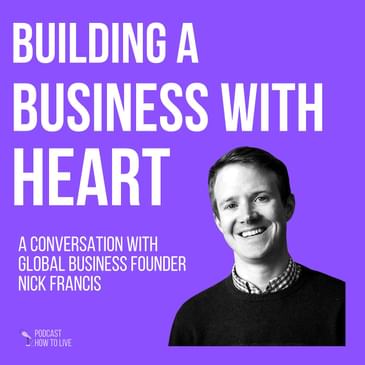
Reinvention for 23-year-olds with nothing to lose is relatively easy. At 40, it's brave. Here's how to do it well.
At 23, Nick Francis left the BBC, drove a Mini to Mongolia, and stumbled into building a creative business now in 9 countries. Back then, it didn't feel brave. No mortgage. No kids. Nothing to lose.
As Nick says: "If you quit your job in your 40s, with kids and responsibilities - that's brave."
Here's what struck me: midlife reinvention isn't about starting over. It's about starting better.
In your 40s, you're not building from zero. You have:
- Clarity about what you actually want (not what you think you should want)
- Skills that compound in unexpected ways
- Networks built on real relationships
- Resilience from surviving previous challenges
The 23-year-old has energy. The 40-something has intention.
Nick's line stuck with me: "We often overvalue the risk of doing something different, and undervalue the risk of continuing to do what we've always done."
If you're questioning your next chapter, you're not having a crisis. You're seeing an opening - an opening to thoughtfully design your next chapter.
This conversation is special because Nick not only shares deep wisdom on reinvention - he also acquired my company last year.
Shownotes
https://howtolive.life/episode/102-building-a-business-with-heart-with-Nick-Francis
How to Live Newsletter One honest thought, every second Saturday. No spam. Subscribe here - https://newsletter.sharadlal.net
Get in touch connect@howtolivecompany.com
About Sharad Lal https://www.sharadlal.net/
Follow on LinkedIn https://www.linkedin.com/in/sharadlal24/
Hi, everyone. Welcome to "How to Live," a podcast that explores ways to live a good life. I'm your host, Sharad Lal. This is episode 103. Today's conversation is very special. I'm speaking with entrepreneur Nick Francis, founder and CEO of Casual, a global company across nine countries. This is close to my heart because Nick was the person who acquired my company, and in that process, I didn't see a shark circling smaller fish. I saw a human being: warm, sincere, thoughtful, someone building with intention and meaning. Nick isn't your typical scale-focused entrepreneur. He's someone who asks bigger questions about values, about what we are really building when we build a business, about how success should actually be measured. In our conversation, Nick and I explore his journey: leaving the BBC to start Casual, evolving as a person and as an entrepreneur, the risks he's taken, the role creativity and storytelling play, both in business and life, and what happiness and meaning look like at the end of the day. If you're thinking deeply about life, about transitions, about reinvention, this episode is for you. The "How to Live" podcast is ranked in the top 3% of all podcasts globally with listeners in 150 countries. Thank you for your support. Now here's my conversation with Nick Francis.
Nick Francis: Hi, Nick, welcome to the "How to Live" podcast. How are you doing today?
Sharad Lal: And wonderful. Sharad, I want to say thank you so much for having me on. It's a... it is an honor.
Nick Francis: Thank you very much, Nick.
From BBC to Entrepreneur: Story of Nick Francis
Nick Francis: You've had a huge amount of success as an entrepreneur. Casual now is worldwide, looked at by corporates for storytelling, creativity. But I want to go back to the time when you worked with the BBC. At that stage, you were looking at maybe getting into entrepreneurship. So I wonder if there was something going through your head, if there was a story, what made you think about entrepreneurship at that time?
Sharad Lal: I mean, I hate to say it, but I almost fell into it. I was working for BBC Breakfast News. I was a producer. I was producing the shows that went on at the end of the news program in the morning. So we were organizing interviews. I was writing stuff that was being read out nationally in the UK to sort of millions of people. Live TV is so humbling. The power of it's incredible. I was being paid 138 pounds a day, which at the time, genuinely I thought I'd arrived. And a friend of mine, and a friend from university, we'd always talked about doing this Mongol Rally, which is a rally for cars from London to Mongolia. So you drive down through Europe, through Turkey, through Central Asia, and then into Mongolia. We'd always talked about doing it, but it was not something we necessarily made a conscious decision to say, "Right, we're definitely gonna do it." We just sort of never really decided not to do it. And because I had this amazing job at the Beeb, I wanted to be able to make a film because I didn't just want to take a three-month time off. So we wrote a proposal, which we sent to all the major broadcasters. I think they basically said, "Listen, two 23-year-old kids... we're not gonna pay you to make a holiday movie." And so we then rehashed the proposal into a corporate proposal with the idea of making a series of diary films. And Expedia, the travel website, gave us a big chunk of cash to go and film and edit these films as we went. We drove in a 1987 Mini. It had a one-liter engine. It broke down endlessly, which drove us completely crazy. But we filmed and edited these films as we went, and when we came back, it was clear that we had this amazing client. We had some cameras and some a bit of money left over in the kit, and we thought, "Actually, maybe there's something here. There's so many companies with so many websites, and nobody's using video." And so, through a few fits and starts, we made some films promoting hotel rooms in London where we got paid 50 pounds a day, which was terrible, really kind of hot, sweaty work, like going from hotel to hotel, filming. But I guess what was interesting actually was so many people said to us, "Gosh, you're so brave setting up a company at the age of 23 or 24." I think actually it wasn't brave at all. We went on an adventure, and we wanted to make some films, and we cared a lot about the films. You never really thought the business necessarily was gonna become this big kind of global organization. I think, you know, if you quit your job in your forties to found a business, right, and you've got a mortgage and kids and car payments and all the things that trap you and pull you back into the corporate life, that's brave. That's really brave. It was only really when we started to have a proper life outside of the company, around about 2011, 2012, 2013, we started getting married, and we started thinking, "Actually, we've built this company. We've won all these awards, and we've probably got something here." We were relatively well regarded in the industry, and that really then inspired us to try to professionalize the company and actually to really focus on making it the company that, I guess, we'd always knew... known it could be, but we'd never really focused on that. We'd always focused on the films and the creative and the storytelling instead.
Nick Francis: Love that story, Nick. One of the things that struck me was at that age of 23, you had a creative streak, but you also had a commercial streak because you went from filmmakers and created a commercial model around it. If I understand, that was early 2004, five. YouTube wasn't there, but you already became a travel influencer. So how did you find those things in yourself?
Sharad Lal: Yeah, I mean, that's a really interesting point. We were doing video diaries and vlogs before anyone had even really heard of YouTube. Between me and my business partner at the time, I think the two of us were quite a good founding pair because he was just very good at getting things done, and I was quite good at getting things right. Quite often he'd send things off, and I'd be like, "No, no, no, it's not ready." And, you know, and then other times he'd come in and be like, "Have you finished doing this create... you know, this film yet?" And I'm like, "No, no, it's not quite done yet." He's like, "We have to send it off." And so I think we were lucky in that we found each other at a time when we really complimented one another's skills.
Scaling the Company Was a Disaster
Nick Francis: So 2011 and 12, when you said you started getting married and things started getting serious, how did that scaling up process take place for you?
Sharad Lal: I think we were probably talking about it when we were in the Mini on the way to Mongolia. We're driving through the Kazakh Desert, and our radio didn't work at all, so we couldn't listen to music. So we just kind of talked about what we were gonna do when we came back, and we had all these big plans about opening up in New York. But it was so fanciful 'cause we were just these kids with camcorders. And then my ex-business partner went to New York in 2009. Came back and was like, "Wow, we... like, we have to do that." And so we got some... some export support from the UK government. They understand that a lot of businesses fail because entrepreneurs don't tend to invest in enough research for the new market. They did a sort of match-funding program where they basically helped open doors with various businesses, and we went to New York and we met lots of people who were running agencies and potential clients. And we got an incredible response from so many of these organizations. But then we came back to London, and I think out of the six major clients we were working with, we had sort of five disaster product projects with five of them. The films were good, but like the... the process that we used to get there was so painful. And we were so focused on making the best possible work we could that we kind of felt like, "Oh, well, if the work's good enough, then they'll forget that it's been a nightmare to get there." What we learned quite quickly is actually if the process to get to a final film's a nightmare, they don't even wanna look at it. I mean, literally, they don't even, like, practically won't even want to open your email, or however you deliver it. And so...
People Make or Break an Organization
Sharad Lal: ...we realized we really had to put our own house in order. And so we recruited our CFO, Edward, who's now our CFO, who's excellent. He'd been at Deloitte, he's a chartered accountant. He actually was a writer in the theater society when we were at college together. And I think he made a decision that he didn't wanna be a struggling writer for the rest of his life, but, but, you know, it's... and so he became an accountant instead. That was great because we had that understanding, like absolute trust. I mean, he's the straightest guy you could imagine. And he's a great friend and he's been instrumental in helping us to professionalize the business. One of the things, funny enough, when I, when I got married to my wife in my wedding speech... this... this sounds kind of cheesy, but in my wedding, we... my wife and I are quite different, but we really compliment one another. And I said in my speech that one of the most important lessons I learned was that like, it's not that you have to do everything well. If you wanna be a good entrepreneur, you don't have to be perfect at everything. You just have to know what you're not good at, right? And make sure you build a company where everyone plays their strengths. And so I said with my wife, I was like, "You know, you take carbon, and you look... and you take, you take iron. Like, they're, they're two very different elements, but you put 'em together, and you've got steel." And it's kind of... it was kind of cheesy. It works as part of a... it's...
Nick Francis: I love that.
Sharad Lal: ...as part of a wedding speech. I think when you're running a small business and you're doing everything, you're sort of chief pot-washer and your CEO and your head of sales, and you, you have all these roles, you sort of feel like you have to do everything. But as you start to build out a team, look for people who really compliment your skills. And, and actually, if you bring good people in, they make the job easy.
Nick Francis: That's such an important thing. People who compliment, people who make the job easy.
Why Commercial Films and Not Creative Films?
Nick Francis: One of the things that I noticed about you through all our conversations is when in the creative space, you could have gone after, let's say, documentary filmmaking, those slow angles, getting the beautiful movement, but you went after something that was commercial and sustainable: corporate films. Was that a conscious decision?
Sharad Lal: So that's a really good question. For many years, we saw the type of brand and corporate work we were doing as a stepping stone to make "proper films." And we had our seven-year itch around about 2013-ish, 2014. Barnaby wanted to make the company into a sustainability consultancy. I wanted to go into doing TV and documentaries. And at the time, I was lucky enough to have some friends who ran TV production companies, and I went and had a couple of meetings with them. The commissioning process was so truncated and frustrating. They'd spend hundreds of thousands of pounds in some cases on developing a project that would just get pulled for no particular reason. So I'd be talking to these people, and they'd be like, I'd be like, "How do I get to do what you do?" And then they said, "Hang on a second, talk me through the commissioning process." So I'd say, "Well, client comes to us, or we might approach them, and they'll say, 'I wanna make this film.'" And we go, "Okay, well, here's some ideas." And they go, "Great." "And how much do they cost?" "And we go, 'That much.'" And they go, "Great." And then they just sign off and write us a check. And they're like, "Oh my God, that's amazing! We need to do what you are doing!" And so, and so, even 10 years ago, it was like, "Oh, wow, actually, it's not necessarily the most... at the time, it wasn't necessarily the most glamorous work, but actually because the projects generally were a bit smaller, and you don't necessarily have so many cooks in the kitchen, and so the creative license that you have over the final output is so much greater in the type of work that we were doing than in, like, big, unbelievable commercials." I had friends who were commercials directors, and they earned unbelievable money, unbelievable day rates. But they only worked for like three, four days a year. And quite a lot of the time it was painting by numbers and being told what to do. And so it kind of made me realize, and they kind of hated their jobs. And so I was like, "Well, actually, what we are doing is kind of great." That then really helped just to like, refocus this understanding that we were building something special, that could be something great. It could be the best version of itself just the way that it was, rather than having to kind of, you know, build something that wasn't necessarily where our greatest strength lied. You should try to well identify what's the one thing you can be best in the world at, your "hedgehog concept," as Jim Collins talks about in Good to Great. Really focus on that, and as he would say, if you have the right people in the right seats on the bus, right, then good... then once-in-a-lifetime ideas will come around all the time.
Nick Francis: You worked, like, with top brands, and you're talking to people who may not be necessarily creative. They're very smart business people, and you're getting the storytelling emotions out. How is that process, and how are you able to get through that?
Sharad Lal: We were lucky in a sense because when we were in the UK when we were starting out, we managed to get in with some recruitment marketing agencies. And the benefit of that to us was that being in with those agencies then gave us an incredible client list because you also have to be a certain scale to be hiring that many people. You know, most businesses don't really have a significant recruitment marketing budget. And so that then gave us this incredible client list relatively early on. But like, it does take a certain skill set, Sharad, it's, it's lots of different stakeholders. You know, there's like brand compliance, there's like complicated payment processes. I mean, you know, it's, it's hard. And funny enough, I think one of the big differences between Casual when we were just in the UK and Casual now is that the delta between our, our, our very best work and our worst work has just like, come way in. When we were really small, it was, it was hard to work with some of these companies. And so, I hate to say it, but some of our work wasn't ideal.
Nick Francis: Yeah, let's put it at that.
Sharad Lal: Let's put it that way, right? Our, our, our best work... our best work was great, you know, I mean, it's like we won a lot of awards, which was, you know, wonderful and like, really helped us to grow the business. But sometimes we just, some of the films we made were just not great. Whereas now, I think, what we sell as a company, we sell reliability because even our worst work is still very good. And so businesses pay... like, they come to us and they pay that premium because they know they're gonna get something that's gonna deliver on the business goal that they might have.
Changes That Need to Be Made From One Big Transition to Another
Nick Francis: If I just go back, you were driving that car to Mongolia and then office in New York. You're getting married. Now you're working with big clients. So there's a huge evolution happening. What are the stories you're telling in your head as you're moving from these different transitions?
Sharad Lal: When we were small, it was all very much about the work. Like, "What's the next project we're gonna do?" Or, "What are the lenses we're gonna use?" Or, "Where in the world are we gonna film it?" And so, narratively, it was far more short-termist. When the business is small, the culture and the values take care of themselves, right? You can have five or six people sitting around a table, and sometimes you'll stay till four o'clock in the morning 'cause you forgot that the client had asked for five films and not four, which did happen. I hate to say. But yeah, around about 2014, the business, particularly in London, had kind of started to get a bit bloated. I think up to about 35, you can keep track of like, you know, roughly when people's birthdays are and what they're doing with their lives. When you get over 35, you kind of can't keep that, like, sort of information. Gino Wickman kind of talks about it in his book, Traction, which I'd recommend to anyone. But he talks about like, the importance of a value structure. And so what we did was we looked at who are five-star members of staff, who were like our absolute shooting stars, and what are the values that they live every day? And then we kind of wrote 'em all down. And then we ended up with five separate values, and then we created a matrix, which allowed us to look at all our different staff and say, "Does that person exhibit that value?" And so over the years we've probably parted company with 30 to 40 people just because they weren't really a values match. And what that does over time, is it builds an incredible culture within the company because everyone gets it. And so now we have offices in nine different cities. Like, that would be inconceivable without that values framework 'cause values is what you do when no one's looking. And in a business that's, you know, run from San Francisco and LA and London and Sydney, there's, there's a lot of time when people aren't looking. So you have to have the right people.
Nick Francis: I love that point on values. And I was just thinking about you at that stage where the company's like corporatizing, and you're bringing these frameworks in, and there's like backlash from people that, "Hey, he's becoming commercial," and some cynicism and snickering. How were you dealing with it? There could be the temptation, "Leave it. Let's focus on the business." But you did the hard work, which paved the way for those nine offices and culture. How at that stage did you push yourself to do this and get some momentum behind yourself?
Sharad Lal: It's really hard because, it's difficult to change your personality or like the way you're perceived within the business. And I think there was a bit of a feeling that like, "Oh, keep your head down for a couple of weeks, he's gonna forget about it." And we... you just go back to business as usual. But it was so clear that the business had to change. Like a lot of those people who didn't work at Casual have gone on and they've got really, really good jobs elsewhere, right? You don't get a job at a company like ours, I'm proud to say, by not being good. It's very easy to just put your values on the wall and pay lip service to them. It's a lot harder to move people on because they don't align. But actually the reason values are important is because it's about building a culture where people can thrive and have the job they've always dreamed of.
Nick Francis: Absolutely agree. And for people listening, I've seen that firsthand with all the people I've dealt with in Casual. You can make out there's a clear culture that has been created, and I think it's been created because of values, because of the decision that you took.
Bringing Together Clashing Personalities in Leadership
Nick Francis: Now you have so many parts to yourself as you're operating. There's this creative part, discipline. You talked about operational discipline. You're also very sensitive to people's needs and empathetic. And then you have the business acumen. How do all these things come together? Do you turn them on? Are you aware of them? How do they come together in your leadership?
Sharad Lal: I'm a lot stronger now than I ever was because I'm far more at home and comfortable with each of the different elements of my personality. I think for a long time, my relationship with my ex-business partner was quite challenging. We built this amazing business together, and it was our skill sets that really helped us. But, like any relationship, it's hard to build something like Casual, and so, we went our separate ways and, it was good for him. It was good for me. That then really allowed me to kind of grow into being a, a true leader. I think before that, because there was two of us, you're always trying to like, balance, and so you kind of cancel one another out. I didn't necessarily wanna kind of strike out and be like, "Okay, this is..." You're slightly measured in your kind of leadership and, you know, in your vision. I think just on, you know, on the vision thing and on the co... the co-founder thing, you know, you can start out both aiming in exactly the same direction, right? If you are, if you have, you know, more or less the same goal for the business, but there's a bit of a difference, right? But then the thing is, if you fast-forward 15 years and you are half a degree off, right? You are, you're, you're a hundred miles apart.
Nick Francis: Yeah.
Sharad Lal: I wish him all the best, and you know, it's... Casual wouldn't be where it is now without, you know, without him and without that relationship then. So, that's kind of allowed me now to just be a lot more confident in my own leadership style. And so, I think on the... the human personal thing that, that's hard, right? Because the last couple of years have been difficult. It's been a difficult trading period. Casual for me was always about... it's about the people and like, bringing people into the journey and the, you know, the adventure. And, and we have wonderful people, and like, unfortunately, there are people, you know, that we've had to part company with because it just doesn't make business sense. You build a company where you're like, you, you want to try and like, really pull people in and like, you know, and, and, and have this like, really strong team-spirited nature of the business where they're all, where everyone's friends, right? And then, you know, if the numbers don't make sense or if they don't quite align, having to kind of like, part company with people is, it's hard.
Is There a Nice Way of Letting People Go?
Sharad Lal: So how do you do this where you want to have the right business acumen and do right for the business, as you mentioned, but also do it in a nice way?
Nick Francis: What have you arrived at as the way of letting people go?
Sharad Lal: I think you obviously just have to be really honest. Honesty. I think I also, you mustn't try and make it too easy for yourself. I think the best ones that ever have been, ones where I've been able to, I say "I," we've been able to find other people, find them jobs, so find them another role, give them a really good reference, help them to, to move on. Bringing people into the Casual Films community team, you know, and then like, what... what's the meaning of that in a world where you're potentially letting like a number of people go? And to be honest, I don't, I actually don't... I haven't quite got my head around what the answer to that is. I think it's just, you know, we'll, we'll, we'll work our way through it, and it will be better, you know, and, and I'm happy to say actually that things are, like, you know, business environment does seem to be getting a lot better, so that's good.
Billionaires Are Often Unhappy. Why?
Nick Francis: Thank you for talking so openly about that, Nick. Thank you. You write a lot, and I love reading your writing on LinkedIn, and there was one article that struck me particularly. You live in San Francisco now. If people don't know about that, and you talked about it having the highest population of billionaires and yet people are not happy. I'd love to get your sense on what you described in the article, "Money, Chase, and Happiness." How do you think about all this?
Sharad Lal: Yeah, it's a really perverse thing because our perception of wealth is not absolute. It's relative. And so, I live in one of the wealthiest cities in the world. I think the... the average income in San Francisco is $165,000 a year, which puts you in the top... I remember talking to a friend of mine, he was saying, "Well, you have to understand that San Francisco is like a fundamentally unsatisfied place." And I was like, "What do you mean by that?" And he's like, "Well, it's utterly irrational to build over a billion dollars in wealth, because you cannot spend it," right? So if you spend $10,000 a day, it would take 274 years to spend a billion dollars. Right? Right. So, so, and yet people strive and strive and strive, and like, money is the deferred ability to get other people to do things for you. And why is that a good thing? Because it gives you time to spend with your friends and loved ones, because ultimately time is the only truly finite resource. I had this amazing session with a coach who came and talked to our Vistage group... I remember a sort of mentoring group, a guy called Todd Musselman. He said, "If you are a breadwinner in your family, you sort of kid yourself that provision is love." And so providing for your family is love, right? And actually, presence is love. Like, being there for your family and not being distracted and not being on your phone... like, and not worrying about whatever car crash is happening at work, you know? And, and yet, like if you know, you look at the wealth, some of the wealthiest people in the world... is our friend Elon Musk... does that man look like a happy man? Right. And he's the wealthiest man in the world. That's the clearest possible legislation.
Habits That Bring Contentment in Life
Nick Francis: So true. But then again, when we have these thoughts, which are so powerful, and we see this wisdom, and then we have the pressure of the company and everything else, is there anything that you found, maybe just small things that you brought into your life to find a little more contentment, a little more presence, or other things that you're trying to bring into your life?
Sharad Lal: So a few years ago I wrote a book, right? And it was unbelievably hard. They say that when you climb Everest, you have to climb it eight times because you have to acclimatize and you have to take gas bottle... air bottles and food and all the rest of it up. And like in a sense, I just thought, "Oh, I'll just bang out 70,000 words. How hard could it be?" But like, oh my, it just took so long. And soon after I'd moved to America, and so for some reason I was still agreeing to have phone calls at 5:00 a.m. and so I wasn't sleeping properly, I wasn't exercising 'cause I was working all the time. I just like, desperately trying to finish this book. I honestly nearly lost my mind. And so now, one of the first things that goes in my calendar each week is the time that I'm gonna exercise. I go for a run on Monday. I see a personal trainer on Tuesday lunchtime. Go for a run on Wednesday. I swim Thursday morning. Go for a bike on Friday. And then I'll go for a swim on Saturday. And like, most weeks I'll miss one of them, right? But I'll do four. I try not to miss them, but like, life happens. And I do that because firstly, it gives me the most incredible thinking time. I'll be swimming up and down, I'll just suddenly be like, "Bam, that's what we need to do." And secondly, when you are running a business in an unknowable world, in an uncertain world, being fit makes you feel strong, and it makes you feel like problems you can confront them and you can overcome them. And, and so like, and so fitness is so, so fundamental. And, and it's, it's about, it's not about being strong, it's about feeling strong. I think I heard you say that on, you know, one of your, one of your podcasts. You know, it's like, it's, yeah. It's, but it's so important. It's like, it's a mindset thing. And of course like, being fit is wonderful as well. So there's, so there's that. And then the other thing that I've started doing is I do ceramics in the evening, and I'll try and do like some ceramics either at the weekend or like at some stage in the week if I've got, got an hour or so spare. And so I'll be making various different vases and sculptures and stuff and just being able to just shape things outta mud, and it's so immediate and it's kind of sensory and it's like, there's no technology. It's unbelievably grounding. It's something that I've found that like, I can just bury myself in and, and so even if I've had a, a hard day, I do that for a couple of hours. I go home, it's like 10 o'clock and then I go to bed, and I feel so planted and I sleep better, wake up better. I think one of the challenges in this kind of computer world that we live in, it's that so little of the fruits of our labor are kind of tangible.
Creativity Is Fundamental for All Humans
Sharad Lal: And I think it's like, it's really important for us. Creativity is so fundamentally human. And, and actually, one of the things I think if I could change one thing about, about all of us is this idea that like, there are, there are creative humans and there are non-creative humans. If you took the most kind of mathematical, nerdy guy out of your accounts department, right? So, Sharad, if, if, if we put you on an island, right? If shipwrecked on an island for two weeks, imagine how creative you would be. Imagine, imagine the shack you'd build. Imagine the fishing lines you'd try to shape. Imagine the harpoons and like, all the things.
Nick Francis: That's difficult for me to imagine, to be honest. But you're right. If survival comes to it, yes.
Sharad Lal: Necessity. "Necessity is the mother of invention," as they say.
Nick Francis: Yes. May... maybe I wanna dig into a little bit more of this. And you've talked a lot about how creative can enhance your life. And right now, I, it was like, "Things that you do have no form. So if you can give something form, which did not have form, that is creativity, and that enhances your joy, and you're using your hands and everything comes into play." I'd love for you to talk about creativity and the ways it can actually enhance life.
Sharad Lal: You know, they say that to live a full life, you need to love, be loved, and to make a difference. And creativity in its simplest form is making a difference. It's making a mark on the world around you. Then you're part of the world. Then you are, you are making a mark on the world. That, I think that's why it's like, it's, it's expression in physical form. And you're making, you're leaving a wave in your wake behind you. And it also allows you to take your emotions and take your inner self. Turn it into a tangible good that can be experienced and shared with others. That's why I find it so viscerally important. It's also that I feel on, like, a really fundamental level that I am a creative person. I finally realize that's just a fundamental element of who I am in the world. And so having a really clear outlet, like the ceramics, just enables me to sort of, to to live as my kind of most genuine self. It's to feel actualized. Creativity is actualizing, which is why it's so important. Humans are nothing without stories. We are incredibly smart apes, but we're also ants. The ant part of our nature as a mass is inconceivable without story. And so, when we cultivated fire 400,000 years ago, it gave us space to, to talk and to joke and to share stories, which during the day, we were always talking very kind of operational terms. It's like, "Go there, do this, do that." Whereas in the evening, you could be far more abstract. And so story developed as our way of communicating, as our brains developed to be able to think abstractly, which is what's so, so fundamental to the human condition. And so our ability to tell stories is arguably our most important attribute, because without, without stories, it's, it's inconceivable to imagine two apes carrying a plank of wood so that they can climb up and reach some bananas high in a tree that they wouldn't be able to reach otherwise, because they're not able to share a story about a condition that can exist in the future. It's such a powerful thing. Storytelling. And if I can just push you a little bit there, what are the stories that we can tell ourselves to make our lives better? So we are the sum total of the stories we tell ourselves. In the same sense that businesses are the sum total of all the different narratives that flow around them. Countries are the sum total of all the different narratives that flow around them. The millions, millions of different narratives, right, that come together into this core. And some of those stories you can control and some of those stories you can't control. But it's really, really important that we catch ourselves with the stories that we're telling ourselves every day, because through them we define our own worldview. And actually, if you can be really proactive about rewriting your personal stories, you can be really transformative in the way that you go forward in your life. So for instance, I mean, frankly, like, "I'm not creative." That like, that's a story. That's a story that you tell yourself that was probably provoked by some incident...
Nick Francis: Craft class in grade three.
Sharad Lal: Right. Yeah.
Nick Francis: Something like that.
Sharad Lal: Completely, completely. You did something in your art class or your craft class, and they said, "Sharad, what the hell is that?" And you went, "Oh, maybe this isn't for me." And then since that point, which is... I think what's it's really important to be careful about the language we use with kids, because so many of the stories we tell ourselves originate in our childhood. When people say, "Oh, you are not funny," "Oh, you're a great storyteller." "Oh, you're a terrible storyteller." "Oh, you're creative, you're not creative," "You're a good cook," "You're good at sport." I mean, how many kids who could have been good at sport just give it up because someone said to them, "Oh, you're never gonna amount to anything." And that just then compounds in their mind. We have the ability to rewrite our own stories, right? But the first step to doing that is just to be aware of them. Think, like, try to catch yourself when you're saying, "Oh, I'm, I'm not good at public speaking." "Oh, I'm not very good at meeting people." "I'm not a particularly fun guy to spend time with." There's all sorts of narratives that when I look back, I, I, I've told myself that, well, it's just wrong. You can rewrite the future for yourself. And I think, we often overvalue the risk of doing something different and undervalue the risk of continuing to do what we've always done, because it's, it's a survival mechanism that we're scared of the unknown. And I think what I've learned as I've got older is actually if you've got a great team behind you and you can believe in yourself,
Nick Francis: You can make incredible changes.
Sharad Lal: That's so powerful. Nick, we've talked for just over an hour, and we've gone deep into so many topics. I thought we'd just throw in a few fun things before we end, if you have a little more time.
Entrepreneurs Have to Make All the Decisions
Sharad Lal: What do you secretly envy about people who are not entrepreneurs?
Sharad Lal: I think one of the hardest things about being an entrepreneur is trying to understand the problem that needs to be solved. Every single morning, you wake up, and you're like, "Okay, what do I need to do today?" And so you're continually making decisions. What I secretly envy is just the fact that someone else is making decisions for you. In fact, well, actually,
Nick Francis: ...at least the big decisions.
Sharad Lal: Right, right. But yeah, I was in the Army Reserves for a time in the UK, and it was funny because we'd go, and we'd have these incredibly tough physical weeks, and a lot of the people were just like, "Oh God, being shouted at and told what to do and, like, how are you getting on with it?" And I was like, "What? I find this incredibly relaxing." And they're like, "How can you find it relaxing? It's exhausting. We've slept for like two hours in the last two nights," and I was just like, "I just, it's very, very clear. They say, 'Go there, do that. Do a hundred pushups, make sure your kit's clean.'" It was just the clarity and not having to continually make decisions about what was gonna happen next. And I, yeah, and I think that was just, that's probably the thing that I envy the most.
Advice for People Who Want to Start Fresh in Life
Sharad Lal: As we close out, Nick, bottom line, what's the advice that you'd leave folks with who are thinking of either going into entrepreneurship or transitioning to a completely new sphere in life?
Sharad Lal: I've always been quite adventurous, and I think that risk is good because, in risk lies potential. If something's scaring you, that's probably an opportunity for you to grow. We spend far too much time worrying about what's gonna happen to us in the future and not enough time realizing that actually we have agency in the future and we can help to write it ourselves. And I don't think I really understood that when I was younger. I felt like the world was something that happened to you. And as I've got older, I appreciate that I'm, I'm an active party within my own life and my own future.
Conclusion
Nick Francis: Very powerful. Nick, thank you very much for sharing all your wisdom with us. Congratulations on all the good work you're doing, Nick, and I wish you all the best.
Sharad Lal: Thank you so much. Sharad, absolutely the same. Same to you as well. Been a real pleasure, and yeah, I hope you keep going. Strength to strength.
Nick Francis: Thank you.