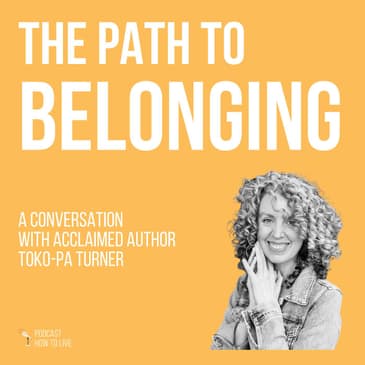
“Most of us think of belonging as an external place, something outside of ourselves, that if we keep diligently searching, maybe one day we'll find. The reason why many of us don’t feel a sense of belonging in our lives, is because we have not inherited the skills for how to practice belonging.”
In this episode we speak with critically acclaimed award winning author Toko-pa Turner. Toko-pa’s book Belonging - Remembering Ourselves Home is a global bestseller and has been translated into 10 languages and counting.
In our conversation, we speak about
- The skill of belonging
- How the longing for belonging leads to false belonging
- Reducing ourselves to fit in
- The symbolic language of dreams
- The creative process - originality vs perfection
- Holding paradoxes
And a lot more.
Related Episode
#026 Owning the shadow
- Spotify: https://howtolive.life/ep26spotify
- Apple Podcasts - https://howtolive.life/ep26apple
Episode Shownotes
https://howtolive.life/episode/027-the-path-to-belonging-with-accliamed-author-toko-pa-turner
Contact us
https://howtolive.life/contact
Follow us
Facebook: https://www.facebook.com/PodcastHowtolive/
Instagram: https://www.instagram.com/podcasthowtolive/
Information on Podcast & Host
How to Live Newsletter
Go deeper with articles every 2-3 weeks. No spam.
https://sharadlal.substack.com/
Leave us a message
https://howtolive.life/contact
About Sharad Lal
https://www.sharadlal.net/
Follow us
Linkedin: https://www.linkedin.com/in/sharadlal24/
Facebook: https://www.facebook.com/PodcastHowtolive/
Instagram: https://www.instagram.com/podcasthowtolive/
The transcript is auto generated. There may be errors in transcription.
Hi, everyone. Welcome to How to Live, a podcast that explores ways to live a good life. I'm your host Sharad LA. This is episode 27. In today's episode. I'm extremely honored and very excited to have with us, Toko-pa Turner. Toko-pa is the author of the award-winning book, Belonging, Remembering Ourselves Home.
This book explores the theme of exile and the search for belonging. Not only has the book won multiple awards, it's been translated into 10 languages in counting and is impacting people across the world, including me. Toko-pa blends the rational with ancient wisdom. She uses the structure from renowned psychologist, Carl Jung and combines it with mystic sophism in which she was raised and puts it all together in poetic language, making her wisdom accessible to everyone.
She founded the dream school back in 2001 from which thousands have graduated today. She spends her time working with people on dream work, shadow work, and in our discussion, we speak about our inherent need for belonging and how it can lead to false belong. Reducing ourselves to fit in dreams, their interesting symbolic language and what they tell us, ancient wisdom versus rational thought, reconciling paradoxes, and a lot more.
This was a very special conversation for me. I've been a huge fan of Toko-pa from the time I read her book and getting the opportunity to have a conversation with her was such a huge honor and privilege. But before getting into the interview, yes, thanking all of you for supporting this podcast. With your support, we hit number three in Singapore, top 5% globally and are listened to in over 65 countries.
Over 500 cities. Please do consider giving us a rating on Spotify or apple podcast or wherever you're listening to this. Thank you in advance now. Here's the interview.
Sharad: Good morning Toko-pa. Great to see you. I hope you're doing well in Canada.
Toko-pa: So nice to be here with you at opposite ends of the time zones.
Sharad: Yes. Yes. 9:00 PM and 9:00 AM, I'm very grateful and honored that you could make time for this. I'm a huge fan. Congratulations on all the success of your book, Belonging. It deeply touched me and many others I know. The concept of belonging is so wide, but I think maybe a good place to start is if you talk about belonging in your book, more as a feeling versus a place. If you could talk a little bit more about that, and how would you kind define belonging?
Toko-pa: I'm not sure that's entirely accurate for me because I actually think of belonging as a skill or a set of competencies or capacities that we in modern times have lost or forgotten. Most of us think of belonging as an external place, something outside of ourselves, that if we keep diligently searching for that, maybe one day we'll find, but for so many people, when they hold that as the framework for belonging, and then they don't find that skill of belonging, then they feel as if they failed in some way but I really believe that belonging is actually a skill. And the reason why so many of us don't feel that sense of belonging in our lives, is because we have not inherited the skills for how to practice belonging.
And so in my book, what I do is I try to first explore the wound itself. I want to understand how we came to be in this, what I would call an epidemic of alienation of exile. And so what are the origins of that estrangement? And in looking at that wound, I believe we can develop some of those core competencies for figuring out how to repair what has been broken.
Sharad: Wow. And belonging as a skill is absolutely a very interesting way to look at it. You mentioned that for a lot of us that longing to belong, being part of a culture is so strong that sometimes we actually end up going towards false belonging. We go to areas that take us away from ourselves and try to fit in. I would love to hear you talk about that false belonging as well.
And how does it come about and ways to get out of it?
Toko-pa: Yes, absolutely. The term false belonging was something that the poet, John O'Donohue, the Irish poet came up with. And just those words, that word pairing for me just resonated so deeply. And I realized there's no better way to express what happens when we have an unconscious wound of *belonging, to belong and we hide it because in some ways in our culture, I think it's considered shameful to admit that you don't feel a sense of belonging in the same way that we hide other things like feeling weak or grieving or going through hard times.
We hide this sense of not belonging. And instead what we do is we pretend or we try to fit in. And I think there's a really distinct difference between fitting in and belonging. One of the great stories that I think illustrates that difference is the story of Cinderella. Now there's the sort of Disney retelling of that story, but in the original Grims fairytale, the stepsisters wanted so much to fit into Cinderella's shoes that they cut off their toes so that their feet would be small enough.
And it's a gruesome image. Like some of those ancient fairy tales really. Quite gruesome. But the image is quite striking and I think this is what we do. We cut parts of ourselves off in order to be smaller, to fit into say pre-designed versions of belonging. And we do this at many different levels, whether it's in a career path, whether it is in a relationship.
Sometimes we do it quite literally with our own bodies, trying to make ourselves fit into smaller clothes or sometimes bigger clothes, depending on what we're after. And so there are other ways as well, when it comes to fitting into groups, let's say for instance, we might want to fit into a certain spiritual group.
But it requires you to behave in certain ways that cut you off from say your natural way. Disagreements with what's being said, or require you to siphon off expressions of anger or sexuality or whatever is taboo to that group.
So this is when we have a kind of false belonging. Where it provides a certain sense of security or safety for us, but there are secret contracts in place which require us to not be the entirety of ourselves. And so they provide a certain kind of safety for a period of time. But over time we begin to feel restless and resentful and uncomfortable, and the unconscious urge for those things that we split ourselves off from start to come back up to the surface.
And that's when we start to feel the trouble of false belonging.
Sharad: That's very fascinating. And I know many of us have experienced it on different levels. Like for me it's a group of friends. Very often we try and fit into a group of friends. And like you said, they're unwritten contracts, the agreements among a group of friends that are always there. And I always find it confusing on one end, a sense of community and being with friends gives me safety, gives us safety, on the other end, like you said, parts of us are cut off because they're not to fit in.
We need to let that go. So how do we? Especially not in extreme situations, how do we balance being who we truly are, and also getting that sense of community and safety, which is so important too?
Toko-pa: Yeah, that's such a great question. And I think a lot of people, a lot of your listeners can probably relate to that in their own way. And I think what you're talking about, finding camaraderie and having companionship, and a sense of community is incredibly important. And you don't want to put yourself in a situation where you feel isolated and alone.
I don't think taking an extreme response to this practice of belonging is a healthy one, but I think there are times when the damage that is being done from being in a false relationship or false relationships will be greater than the benefits that we derive from them. And each of us has to determine where that is.
But I think it really is a kind of inside-out job. So rather than thinking of it, I need to drastically change my life situation from the outside in. We actually have to begin internally and really start to understand what are those things that we've cut ourselves off from. And each of us has a set of things which you know, in the Yung world, we would call that the shadow.
It's the place where all of those things that we have denied or not yet explored or have been denigrated in us, or somehow are devalued by the culture. And therefore we repeat that devaluation. They go into what the poet, Robert Bly calls the long black bag we drag behind us. That's his image of the shadow because it's not as if we disconnect from them, we actually carry them.
And it is a kind of weight to carry them, even if we are carrying them unconsciously. And so what happens for a lot of people is it isn't actually a conscious decision to separate from a place of false belonging. Life can do it for us. And that might look like getting fired from a job, or it could look like a sudden illness which takes over our lives, or it could look like a breakup. Any kind of moment where we're suddenly disconnected from that place of false belonging and we enter into a period of what I call in the book, an initiation by exile.
Whether we intended it or not, life has a design for our lives. And these times of exile of great loss and hardship are really a sort of initiation. And we see this in many of the ancient fairy tales and myths, where there's a period where the hero or the hairpin must endure a time of exile.
Where they enter into the dark thicket of the forest and they have to face difficulty and hardship in order to become who they truly are, to find the medicine of their vocation, of their true purpose, of their calling. And we all experience times like this, I'm sure Sharad you can relate to those moments.
There tends to be pivotal moments in our lives but where everything has to change. Sometimes we call this midlife crisis. Other times, it comes at earlier points. There are various transition points that naturally happen in the cycle of aging and there are times where we are forced into a kind of aloneness, a kind of solitude where we have an opportunity to really begin to look into that long black bag and find what lives there and what is trying to get our attention.
So it can come back into belonging with us. And so you see, this is the internal work of belonging, where we have to belong ourselves to those parts of ourselves that have been thrust into exile that have been turned into refugees from our own lives.
Sharad: Wow, that is so powerful. And I have experienced it like you mentioned, and most people I know have experienced that exile and what I've always been fascinated about that intellectually. A lot of us know that these dark times are when we actually need to go deeper, maybe face our shadows and come out and be our authentic self.
But when we are in there, it's so difficult. You can't see this will ever lead to something good. And I know you've been there many times and come out a lot stronger, but I've also noticed that sometimes people wilt under that pressure. What is the skill that's needed, where we can do the hard work, see the shadow and emerge from exile in a stronger, more authentic way versus wilting?
Toko-pa: That's such a beautiful question, and I'm really glad you asked it because there can be extreme hardship sometimes so hard and sometimes so long that we can really be seduced into despair. And some of us may not even have what we feel is the resiliency to emerge intact or stronger from those times.
And I just want to acknowledge that this is more than a personal problem because people can take this very personally and think I am failing at being resilient, but actually I really think it's a cultural ailment because, in our culture, we focus so much on the triumph, on the emergence, on the heroic transcendence of difficulty.
We see it all the time in our movies and stories. And the focus of our modern myths is on the warrior mentality. But nobody ever talks about how long that reckoning can be and how hard. And so one of the things that has really become the passion of my life and where I have focused all of my energy for decades, is on the practice of dream work. The reason why dreams are so important is because here within us is this biological impulse to story our lives forward. I think we come with an even born story for our lives. Some people call that destiny. And it just means that there is something that is pulling us into the future.
There is something that we, each of us are meant to become. And I just wanna take a moment to differentiate this from the way that most people think of purpose as if there is a singular purpose that each of us is supposed to embody. And this doesn't quite resonate for me because, I think you can’t spend your whole life searching for that one pair of shoes that fits you so perfectly.
But I think purpose is a whole complexity of things that just involve becoming more of who we are. It's the same as anything in nature, any tree, any animal, any instinctual nature is designed for it by a higher intelligence. And we are no different, embedded in the exact same ecosystem.
We too have a higher nature, a kind of becoming that we are meant to step into. If we can learn to understand the language of images of metaphor. We have a much better chance of coming into that purpose and in our culture. When I say our culture, the dominant culture, as opposed to many of the indigenous cultures who still retain practices around dream work, we have completely denigrated dreams even.
In psychology, which I would say would be the only place where you could find any veneration of dreams, but it's so small. It usually represents just a fraction of say a postgraduate level education. We might mention it in passing, but really in our culture, we have completely lost the teachings around how to tend to and understand our dreams.
And yet we spend a third of our lives in the dreaming state. So there's a huge amount to be said there, but I've made it more complicated, which was I think a powerful question, but what can you do in those incredibly dark times? I think you can turn towards your dreams and at least start to become curious about the dreams that you're having, because that is the place where the exiled self will first begin to knock at your door and often show up in the form of nightmares because they have been neglected.
For so long that they have to turn up the volume to get our attention. One of the most amazing things that Carl Jung discovered in a study of dreams was for those who don't know was the great Swiss psychoanalyst and the founder of analytical psychology and a great pioneer of dream work in the west discovered. That when you have a recurring dream and let's say you've had that dream for 20 years, when you finally understand what that dream is trying to tell you, the dream stops and a new dream presents itself.
And so the implications of that are profound. Which means that something in us knows which way to go. And it's drawing us into that future.
Sharad: That is so powerful. There's so much to unpack there. There is a force that is in those difficult times, your innate wisdom, there's a force that's moving you forward. And one very powerful way it shows itself to you is through dreams. Of course other things like institutions, but none of this can be found in the rational world.
If you're looking for answers in the rational world, what's happened to me? That's not where you get the answers, but if you look at ancient wisdom, there's so much work that's been done on things like dreams. That's where you can get some of these answers. I find that fascinating for people who have not paid too much attention to their dreams and I'm one of them.
I actually started paying attention to my dreams after I read your book. And I can maybe later tell you about some dreams that were similar to some dreams that you mentioned in the book, but I'll come to that later. But for people who haven't paid attention to their dreams, what's a good way to get started?
What can dreams tell you? What should we think about them?
Toko-pa: It's important to remember that this is a language and it is a language we have no familiarity with, most of us. And as a result, they can appear like nonsense to the rational mind. So that's why we forget them because we don't value them. We have to be patient with ourselves when we're at the beginning of the journey, because we can look at it and it seems to make no sense.
One scene leads into the next scene that has no sequel or they may have images that don't belong to each other or that feel impossible. The first thing that we have to learn is not to dismiss them. And the easiest way to do this is to improve your dream recall.
And you can do this with a few simple steps. And if people want to learn about that, I have tips for dream recall both on my website and on *my. If you just search my name, Toko-pa and tips for dream recall, you can maybe link to it.
Sharad: I'll put it in the show.
Toko-pa: Perfect. If you first start to remember your dreams, that's a huge first.
And then one of the most important things is that you actually write your dreams down. This has a twofold effect. One is that it is by its very nature, giving it relevancy, right? Because you are putting them down, you are materializing them. The other thing that it does is it helps to grow that muscle to start to build a bridge between the seen and the unseen worlds between the rational and the wisdom. This is a good start, but then learning to understand symbolic language really takes practice. And I do teach courses in thi. For some people, what happens is they actually have a natural propensity for thinking symbolically. And so for some people, it could be quite an easy shift. For other people who are very deeply immersed in the rational world.
It can be a harder shift and there can be a lot of resistance and dismissal to that. But what I like to remind people is that we actually have these two hemispheres of our brain, and the right hemisphere is the one that tends to be the most underdeveloped in our culture because we focus so much on a rationalistic approach to life.
And everything that is unseen or intuitive or felt or deeply known or is *image tends to Dismissed. So you really are fighting an uphill battle with learning symbolic language, but that doesn't mean to say that it can't be done. This is the realm, that hemisphere of the brain is the realm of creative imagination.
So all of the greatest inventions of human culture have come out of that place, from the discovery of great scientific methods to symphonies and some of the great novels of our time have come out of the creative imagination. So if that helps to lend some credence to developing that there are a lot of payoffs for developing that capacity.
Sharad: Absolutely. I come from the rational school and I'm trying my best to understand the symbolic language and human creativity. I was rereading your book recently. There was this dream that he talked about. Somebody had this dream where he was trying to go to the toilet. And he couldn't find a toilet.
So he kept going to different toilets. I had the same dream a few days back. you'd explained it as a toilet is the place where you're alone and you have your space and that's the place where you're totally relaxed. And it's symbolically trying to tell you that you're not getting your space that you're looking for.
That's the way you looked at it. And that's exactly what was happening to me. I have two little kids, one toddler, one infant. I wasn't getting time to myself and that was the message coming to me. So even for a person like me, who is so rationally involved, a little effort can help develop that muscle.
Toko-pa: Yes
Sharad: I found that fascinating.
Toko-pa: Oh, that's great. I'm glad that helped, and most dream symbols can be understood with the knowledge that you already possess, but it's just a matter of learning how to think symbolically instead of literally, right? So in a dream where you're looking for a bathroom, if you want to understand what a bathroom means, you can just ask yourself some sort of rational questions and say what is a bathroom?
A bathroom is a place in the house where I have complete privacy, a bathroom is a place where I'm quite vulnerable. It's also a place where I release tension from my body. It's where I work things out, so to speak or where I cleanse myself, whatever comes to you through your own associations will help to contribute to the understanding of that metaphor.
And so it's just a matter of being able to take a little bit of a step back from immersion in the dreams, say literal experience for you and your dream body and being able to look at it symbolically. While there are no universal ways. We can start with a universal interpretation of a dream, but I don't recommend that people use dream dictionaries because every dream is so specific to you, the dreamer and your experience.
So for instance, if somebody had that dream and they dreamed of going into the toilet, but the toilet was overflowing. Because a lot of people have that dream. That's a very different dream from having a dream and every time you find a toilet, there are people inside or watching you. Those are very, very different details, which will have completely different interpretations.
The one where toilets are overflowing may suggest to you that there's a lot of stuff coming up for you, unconsciously that could look like being triggered and having a lot of emotions come up or just not understanding why you're feeling so upset at this time in your life. Or stuff from the past coming up, or it could look like not having enough space to process and, cuz when you flush something away, there's a release.
So that would be very different from a dream where people are looking in on you, where there's a sense of self consciousness, and of people being in your emotional, psychic, physical spaces, of not being able to know who you are without those intrusions and interventions. So you see two dreams might look the same, like unable to go to the toilet, but they have very different details, which sort of zero in on this specific issue to the dreamer.
Sharad: Understand. I know you've had a background in Shiism and that's come into your dream work. And I know you bring that as well as you mentioned Carl Jung earlier, I'm wondering how do you bring those to the rational part and the ancient wisdom together in how you do dream work with people?
How does that come together?
Toko-pa: That's a good question. I have to say I wrestle with that every day, because like everybody else, like yourself, I was born into this rationalist culture. For the last, since Le cart in the 1700s, we have scientific materialism as the mythology of our time. And so it permeates everything from our focus on calendars and clocks and schedules and evidence based thinking to, if I can't see it, it doesn't exist.
And so there are huge amounts of obstacles to being in touch with the right hemisphere to that intuitive creative imagination. So it's really I think collectively a rehabilitation process, a kind of rewilding that we have to do to gain access to that part of ourselves.
But that isn't to say that we want to throw out the rational mind because it's incredibly important. It is what allows us to live in the world, to participate in society, to make a living, to have to behave in the ways that are accepted in culture and so on and so forth.
So finding a balance between these two sides. I think it really is the work of our time, but to answer your question in dream work really I try to change the order of those two functions so that the rational mind is demoted to following the intuitive. And so what that looks like for me is when I'm working with another person in their dream, I am really more than anything receptive.
So instead of trying to do something like an interpretation I actually don't really use that word very often in my work because I believe that what's really needed when we're doing dream work with others or when we're doing it with ourselves is receptivity. This is the opposite of the Jung mentality, which wants to get in there and figure things out and get to a bottom line and get something from the dream or what I call the acquisitional approach to dream work.
We're actually just trying to hold space for it. This is much harder than you might think because what I wanna do is draw the dream out. I want to create a kind of openness and a spaciousness and a curiosity for the dream to emerge for the animated life within the dream to express itself to me.
Most of the dream work, if I'm working with another person, is quite literally 90% curiosity. I wanna know, how did that feel? What did that look like? Who is this person? What are they like? How would you describe them? What time of day is it? What does your body feel right now at this moment?
What am I missing? What are you feeling? I'm asking all of these questions to get a really embodied perspective into the experience of the dream. And when I have done that for say 45 minutes, I really feel that I understand what the dream is saying, what the dream is longing for, what the dream wants. And if then, that's when I bring the rational in and the rational has the ability to then gather all of those pieces.
And then instead of pulling things apart, which is what the rational mind does, it's like surgery where you pick at things and try to pull them apart and analyze them. I don't do that. I use the wisdom method, which is to coalesce how do we bring all those pieces together and find how they fit together?
In the final part of a dreamwork session, I am now trying to recapitulate what the dream itself has said to me through the dreamer into the form of a story. So I'm retelling what has been told to me. And so it's a kind of mirroring work. And what emerges from that process is really quite miraculous because that's all that really wants to happen is a sort of listening, a mirroring, a curiosity, and then this recapitulation which in and of itself carries wisdom and teaching that changes everyone involved.
So being witness to that is the change itself. Instead of trying to acquire something from the dream that will tell us which way to go instead, we are metabolized as we metabolize the dream, we are changed. And then we know which way to go.
Sharad: Wow. Thank you for describing that process in detail. Thank you very much for that. I think there's some chapters where you write about the creative process that resonated strongly with me. And many people who are again with a rational bent of mind are trying to do something creative. And I guess it was in a big black bag in the shadow, which we're trying to bring out now when we were doing it.
What resonated with me was this whole thought of perfection and comparison. Which you talked about when you're not trying to be perfect and you're trying to be who you really are. That's where originality exists and once you are original, then there's no need for comparison.
If you could talk a little more about this whole creative process, perfection comparison, because all of us get caught in this. When we look into the creative process, I would love to hear you talk about it.
Toko-pa: Yeah, I love words, as you probably could tell. I love looking at the roots of words because when we take them down to the roots, we understand them in a way that isn't root, and the word originality in the root of the word is origin. And so for me, going into dream work really takes us back into those same origins that all of life springs from.
This is another way in which I think we are deeply helped by dream work and every creativity that I undertake in my life has always been fed by this well spring that comes from my own dreams and from the unconscious. Originality also means that we all have access to those origins.
I really believe that psyche is something that extends far beyond the mind and the personal unconscious, but is actually a shared ecosystem which is why sometimes when you have a great idea, you can see that idea emerging in someone else's work and you think, oh shoot, I should have done that thing because there it is in someone else, but I think this is because we are collectively trying to work things out together.
That sort of turns the idea of comparison on its head a little bit, because then it becomes much more, less about comparison and more about cooperation. We can think of this as a project we're working on together, but also that each of us has access to that spring of imagination and so perfectionism is really the idea of matching an image that has already been created.
It is not actually original. It is a memory of a preexisting cosmic, something that exists in your unconscious or in the unconscious, the collective unconscious. Whereas perfectionism is an external image that has been created and refined and developed already by culture.
It's a place of a very different origin. When we try to match up to an idea of perfectionism, what we are actually doing is homogenizing ourselves, right? Because perfectionism means we all want to look like that, or we all want to sound like that. That's why, when you say, listen to top 40 music on the radio.
All the songs sound the same, right? Because they've just been homogenized and there's no life force there. And it could be comfortable and it's familiar. And maybe we like it because it's trendy, but trends really just pass and fade. If you want something truly original. Usually you have to do something weird.
You have to have something eccentric. You have to have something that has mistakes in it, and that feels rough and that doesn't fit in and that's changing the image of perfection. This is what I really invite people to exaggerate that thing that is unique and original about themselves.
That probably other people will say that was interesting or weird at first, but could be the thing that really thrives because what we need more than anything in this culture is that creative imagination. We need different kinds of thinking so that we can create a diverse landscape of art and ideas.
The only way to do that, is to step away from that image of perfectionism, which is inherently dead editing because it can actually never be achieved. Humanity is, and all of nature is not meant to be perfect. It's meant to be variable and different. And that's in a way when you put all of that diversity inclusively together, you have perfection because there's so much variation that it creates a kind of symphony.
Sharad: Wow, that's beautiful. I was just thinking, as you're speaking, like practically, how do you have the discipline to go and follow your originality?
And just go down that path, even though you may not be getting claps along the way, or you may not be getting the normal reinforcement that you get. I wonder if there's anything else through which one can pursue that authentic originality.
Toko-pa: I think one of the first things to remember is that when you are on the path of originality, you are going to encounter so much inner invalidation. So all of those voices are going to come up and say, “That's not smart enough. That's been done before. You are not original. You don't have anything to contribute.
This isn't beautiful.” You're just going to hit this wall, every creative person goes through this, but nobody really talks about it. It's really important to say that this is familiar territory for anybody who's achieved anything creative. You're just going to hit those walls over and over again.
The tension that is created, is part of the creative process itself. Tension is necessary to your creativity.
You have to wrestle and have those inner conversations and stand up to those voices that tell you, you're not doing anything good if you want to wrestle something out into the world. But I think one of the biggest things we have to remember is.
What we're doing is not creating for the external world, because as long as you have that perspective of what do people want to hear, or what are people going to like me for, or what is going to be successful? All of those are measurements of the outside world. As long as you're focused on that, you're not gonna get very far.
You have to break those allegiances in a way and really turn your allegiances to the inner world and say, what is most important for me? What do I need to say? What gives me excitement? What makes me angry? What do I wish would change? What is the thing that I crave to hear from others?
And don't hear. How can I be that voice of change? That is very scary. It's scary to do that because when you're saying something that other people aren't saying, it can feel really edgy and risky and you know what it is. And there is a chance that you could meet with criticism for doing that.
But it is the only way I think, to do something that is valuable, that is different. And you know what, we only have this tiny blip of a life, just a few short years on earth that we know of and as long as we are adhering so much to these rules and regulations of culture especially in a culture that is so fraught and is so backwards in so many ways, and that is hurting so many people and with all of the sort of precipice of crisis that we are on right now, have we ever needed to have those different voices be heard than now?
I think not.
Sharad: Absolutely, that is so inspiring Toko-pa and reading your work, I know the authenticity with which you put it together, I know it would've taken you a long time and you put yourself in the book, it became so popular.
For so many people, it resonated with them and you were living your own quiet, authentic life, but suddenly people wanted to reach out to you to hear from you. How was your personal journey from being this quiet, creative, suddenly in the spotlight and sought after? How's your journey been in this process?
Toko-pa: It's been so many things, I think probably my biggest experience is one of disbelief because as a writer, my life is inherently introverted and it has been for a very long time. It's not as if I had just decided to write. And then this book was successful.
I've been writing my whole life in relative obscurity. And because the book has a kind of life of its own. It has traveled into all these different corners of the world. And I'm amazed to say that belonging has been translated into 10 different languages already which is just mind blowing to me, and this is not even a book I can any longer read because I don't know these languages.
And yet people speaking those languages in the Czech Republic and in Poland and in Korea are reading this book and having an experience and a relationship with it. So I would say my most predominant experience is one of having a hard time reconciling even though years have passed and I should get used to it by now.
I think there may always be a level of me not quite being able to understand the extent of belongings in life. But I remember when I just released the book or was just about to release the book, I had a dream that I had a child and the child even though it was just born was robust. It was like a strong little boy.
And it was too, I couldn't even lift it because it was like a heavy, he was a heavy little boy and running around and you know how boys are when they're small. and I thought this was a very good image for belonging and there was a real sense of, it has its own life. Yeah, so that's mostly how I think about belonging as it's, if it wants to travel the world, that's what it's going to do.
While I sit at home, wrestling with demons to write my next book
Sharad: That is so beautiful. And here also, you mentioned not reconciling and earlier, you'd also talked about tension between when you are doing the creative process and in your book. I noticed a lot of places where you talk about holding paradoxes. Holding different thoughts and again, the rational mind finds it difficult to have two very separate thoughts that it's holding, being authentic, but also being externally focused. How do you hold these paradoxes, what is it? What is it that you do? How do they sit with you?
Toko-pa: It's a great question. And it's a huge question and I think that's one of those questions you could keep asking yourself for a lifetime because there I am not sure that I get, so sometimes it gets easier. There are some things where I think at this point in my life, I'm able to tolerate paradox much better than I would have in my twenties.
And I'm much more comfortable with things coexisting and gosh, in terms of a political climate in the world, I don't think there has ever been a more important time to practice at this skill of getting off the binary and being able to see how things can coexist. We can even take that one step further and say, it's not just binary.
It's like, there's a whole multiplicity of perspectives that are possible to carry at once. We see this in our dreams all the time. When you just consider it for a moment, it's like having a Greek chorus living inside your psyche, there's this huge crowd of personalities and identities that live inside of us.
And each one of them has something to say and has a valid perspective. The more you work with your dreams, the better you get at learning to tolerate multiple perspectives. But of course there are some things that are much harder to carry. When we have these splits in culture or splits in our lives between two very strong ideas, I would say these are pivotal moments, where we really have to work consciously to practice giving relevance to both.
And so holding paradox is a way of coming off a one-sided perspective. So what our dreams often do is when we have two, one sided perspectives about something, they show the other perspective in an extreme compensatory way. What would be an example of that? Say we are working all the time and we are just focused a hundred percent of the time on work and maybe we're even a workaholic.
We might dream about a lazy artist who doesn't care about money and is perhaps even flouting you and your desire to get organized. This would be a good example of the dream, providing a compensatory image for us to consider. Is there any value in that perspective?
How can I do it? It's not to say we wanna swing the pendulum to the other side, but is there a way to give an hour of every day to just doing nothing or to doing something that seems irrational or to really putting some workaholic energy into being lazy, and finding a way to balance these opposites.
Ultimately, if you practice at that, that's a core piece for you, but if you practice at it, these things start to find a balance where both of these things can coexist. You can be completely lazy or you could be wonderfully artistic and still get work done in a way.
Actually, you may find that giving some of your energy to that creative archetype improves your rational life. Because being in the creative imagination. As we've seen time and time again, empirically in studies, being dangerous and giving energy to that side of your imagination actually improves your ability to solve problems and to be organized and more focused.
Holding the paradox such as for me in the example that you used watching my book become so successful. The work for me is really being able to integrate a bit of that success, and really give lend a little more value to the work that I have to offer in the world, instead of always just wrestling with the hardship of doing it, but maybe taking a vitamin C pill of that juicy goodness to balance things.
Sharad: Thank you. That was very nicely put again, it's beautiful words that you put together and then it gives somebody so many useful tools to explore this. So thank you very much for that. Is there anything else that you'd like to talk about? I've spoken to you for an hour that doesn't feel like an hour.
Is there anything you think we should discuss?
Toko-pa: I was thinking maybe I could just read a little invocation from the book. How would that be?
Sharad: That would be awesome.
Toko-pa: Okay. I'll just tell you, there's a funny story behind this which is when we were designing the book in printing there has to be an even number of pages when you print a book because of the way books are constructed.
And we had this empty page left in the book and it was going to print. And the designer reached out to me and said do you have something we can put on this page? And I said, no, but let me write something. So you can understand. I went through the five years of writing this book and I thought well, how do I summarize what I wanna say for this empty page?
This is the prayer that I wrote for the rebels and the misfits, the black sheep and the outsiders. For the refugees, the orphans, the scapegoats, and the weird house for the uprooted, the abandoned, the shunned and invisible ones. May you recognize with increasing vividness that you know what you know. May you give up your allegiances to self doubt, meekness and hesitation. May you be willing to be unlikable and in the process be utterly loved. May you be impervious to the wrongful projections of others? And may you deliver your disagreements with precision and grace? May you see with the consummate clarity of nature, moving through you that your voice is not only necessary, but desperately needed to sing us out of this mud. May you feel shored up, supported, entwined and reassured as you offer yourself and your gifts to the world.
May you know, for certain, that even as you stand by yourself, you are not alone.
Sharad: Wow. Thank you for that. That is so beautiful. And seeing you, I wish this was a video recording. Seeing you speak this, I wish a lot of other people got the pleasure of doing it. The emotions, it was beautiful. I don't even know how to put it in words. I would not do justice. Thank you for that. I have one last question, Toko-pa which I ask everyone at the end of your life, how would you know you've lived a good life?
Toko-pa: Oh.
I think my greatest aspiration is to be kind. It always was. I remember meeting somebody when I was very small, who I found to be kind, and I thought that's what I wanna be when I grow up. I want to be kind.
Sharad: You are kind, thank you for saying that. And thank you for all the work. You're such an inspiration. You had a difficult start in life and anyone who reads the book will see that. And from that start to come out and give so many gifts to people. It's truly honorable. You're doing such a service Toko-pa.
It's been a complete honor speaking to you, and I'm very grateful. You made time for this. Thank you very
Toko-pa: Oh, Sharad, it's been so lovely to talk with you and me too. And I hope that our paths will actually cross, you never know in the three dimensional world.
Sharad: Yes.
Thank you. Toko-pa for such a deep, powerful conversation. Some of you may have noticed I got a little emotional towards the end, seeing Toko-pa, experiencing her energy, feeling her presence moved me. I hope you enjoyed the stock as much as I did. If this resonated with you, you could consider listening to episode 26, where we talk about the shadow.
It's a primer on the shadow as Carl Jung called it. Here's one action step we could all consider: let's reflect on an area of false belonging, maybe in our past, that's easier to do what drew us into it. How did we enjoy it? When did we start getting uncomfortable?
What had we cut off in ourselves to fit in? How did we exile? What was exile like? And what can we learn from this experience? These are some guiding questions, but feel free to create your own questions and reflect in any way. I hope this exercise is useful for you. That's it for today's episode, we will be back in two weeks time for another episode. I hope you join us for that till next time. Have a wonderful day ahead. Bye bye.